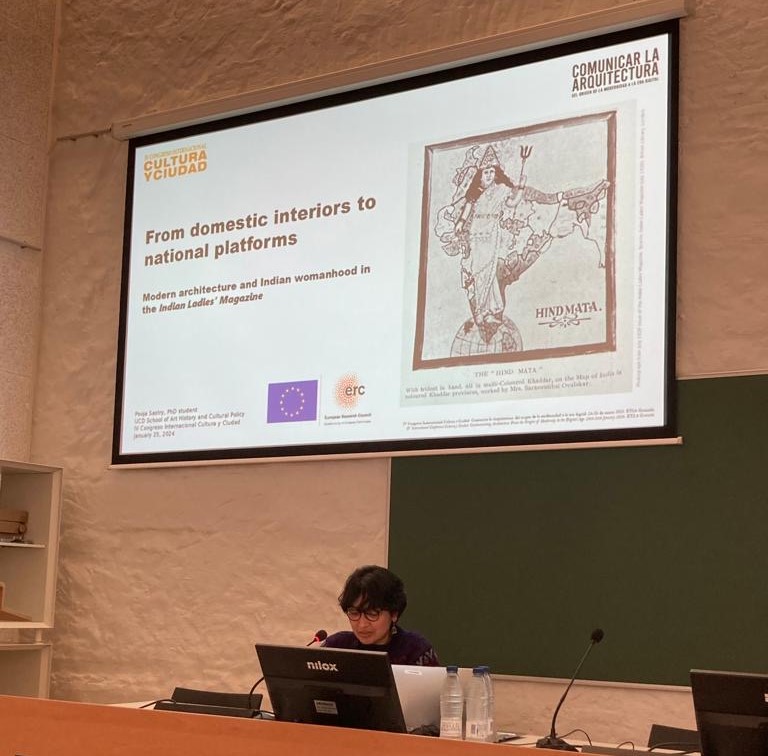
Pooja Sastry – IV Congreso Internacional Cultura Y Cuidad, Granada, Spain
This paper will focus on the rich cross-cultural exchanges that informed the dissemination of modern architecture in India in the 1930s as seen through the Indian Ladies Magazine. Published in two runs from 1901-1917 and 1927-1938, the Indian Ladies Magazine was an English-language magazine edited by Kamala Satthianadhan and her daughter Padmini Satthianadhan Sengupta. Based out of Vizianagaram on the eastern coast of India’s peninsula
midway between Calcutta and Madras, the editors moved in the social circles of both colonial cities, actively participating in intellectual debate on the intersection of western civilization and emerging Indian nationalism in this period in British India.
As with women’s magazines in other parts of the world, the Indian Ladies Magazine sought to navigate the tension between the work of women in the public sphere and the work of women in domestic spaces 1 , which in India was imbued with the further dualities of Hindu/Christian, indigenous/alien, inner/outer and spiritual/material. The editors of the Indian Ladies Magazine wielded what Deborah Logan (borrowing from David Finkelstein) calls a “cultural ambidexterity” 2 to forge a vision of Indian womanhood that combined chaste Hindu modesty with a modern spirit of autonomy and self-sufficiency.
Educated in English and multilingual, Satthianadhan and Sengupta read widely and borrowed from contemporaneous Indian publications in Hindi, Telugu, Tamil, Marathi, and Bengali, as well as magazines published in Britain and the USA to address their women readers. Content included a section called ‘Household Hints’, in which they quoted from British and American magazines to advise Indian women on home decoration, with accompanying photographs of rooms with modernist furniture. One of these photographs is of a set of sofas in a living room overlooking a fenêtre longue, a type of iconic window now widely associated with avant-garde architecture in the west, but which was still relatively uncommon anywhere in the world in 1937. This speaks to Satthianadhan and Sengupta’s discernment in linking modern architectural forms to modern Indian womanhood.
As Peter Scriver and Amit Srivastava have written, we may assume that English-speaking – and therefore upperclass and elite – Indians in 1937 had some familiarity with the Lutyens-Baker style of imperial New Delhi and Art Deco buildings in the erstwhile Bombay Province 3 . The inclusion of the photograph described above in an English-language Indian magazine published by women for women suggests that images of modern architecture that were being disseminated to readers in 1930s British India may have been more wide-ranging than previously thought and also that women in India played an active role in the communication and dissemination of these images.
1 Dolores Hayden, The Grand Domestic Revolution: A History of Feminist Designs for American Homes, Neighborhoods, and Cities (Cambridge, Mass.: MIT Press, 1981): 119
2 Deborah Anna Logan, The Indian Ladies’ Magazine, 1901–1938: From Raj to Swaraj (Lehigh University Press, 2017): xx
3 Peter Scriver and Amit Srivastava. India. Modern Architectures in history series (Reaktion Books, 2015): 81-111
 Expanding Agency: Women, Race and the Global Dissemination of Modern Architecture
Leave a comment